
The Eagle and the Airman
H is for HawkThe meeting of hawks, aircraft, and military imagery forces Helen to question fantasies of safe distance, power, and innocence in the sky.
increasing Bearing strength in each event
 decreasing
Bearing strength in each eventdecreasingA Childhood of Aircraft
Looking Up at War
Planes Above London
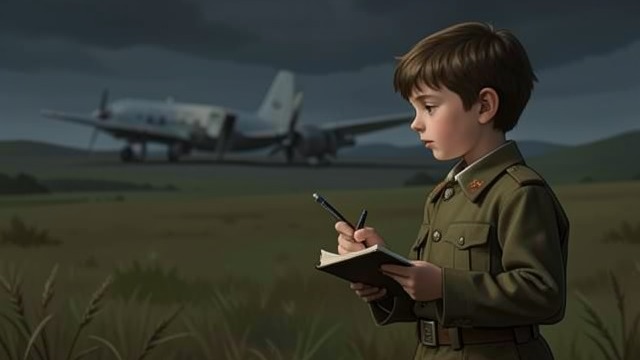
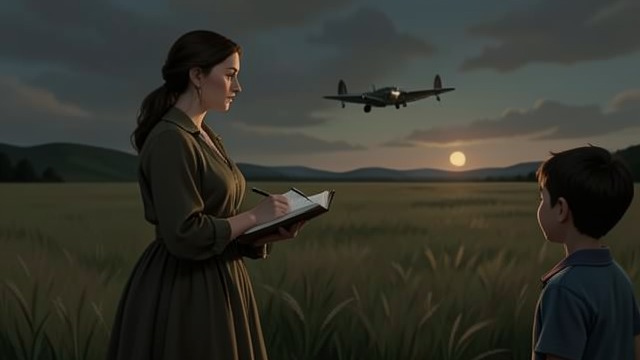
Helen’s father grows up under aircraft crossing the sky during wartime. He learns to distinguish types by engine sound, shape, and position, turning observation into a way to understand danger.
A Boy’s Collection
He records aircraft and gathers information with the intensity of a child trying to order a disrupted world. The habit later becomes a lifelong practice of looking and recording.
His childhood sky is both threat and a route into imagination.
The Bomber’s Passage
A Flying Fortress Appears
A Sudden Aircraft
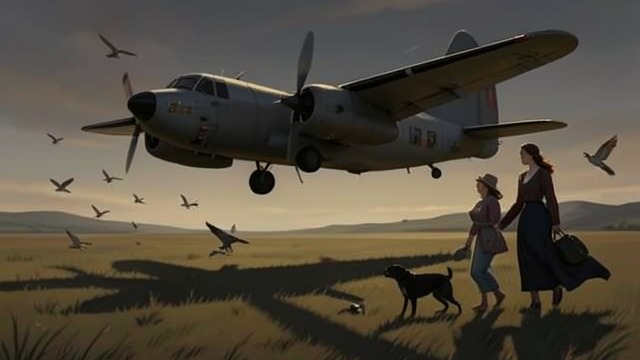
A Second World War bomber crosses low over Helen and Mabel while the hawk eats a rabbit. The surrounding birds scatter, but Mabel continues feeding.
A Different Response
Helen feels both fear and fascination at the aircraft’s scale and sound. The moment recalls the American airmen who flew into lethal combat and complicates any easy image of the sky as a place of safety.
The same sky holds hunting, memory, and human violence.
Auden’s Vantage
The Eye Above
A Poem Returns
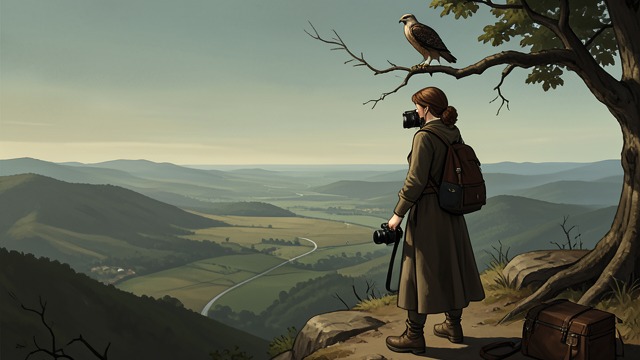
Lines from W. H. Auden come back to Helen as she considers the hawk and the airman. Both possess a commanding view of the world below, with the possibility of death descending from above.
Distance Is Not Safety
Helen recognizes the attraction of watching from a position that seems invulnerable and complete. Her father’s photojournalism used a lens for protection, but the lens could not remove him from the world.
The high vantage offers perspective while concealing responsibility.
Falcon and Spitfire
A National Image
A Seamless Transition
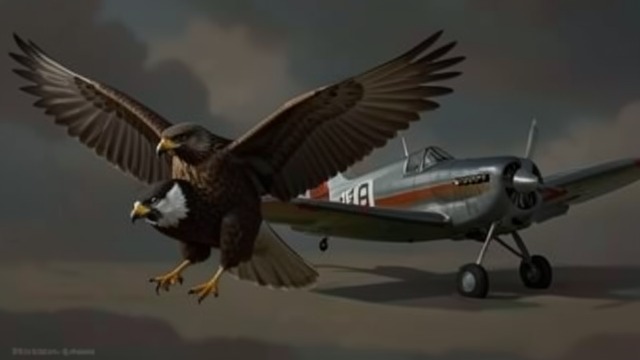
A film moves from a medieval falcon to a diving Spitfire, making the two images seem like successive expressions of one enduring national character. The visual cut turns resemblance into historical continuity.
A Myth Made Persuasive
The image joins romantic medievalism to modern military technology. Helen sees how the hawk’s prestige can help make warfare appear natural and honorable.
The aesthetic power of the image is also its political danger.
Choosing What to See
The Limits of the View
A Story for the Memorial
Helen recognizes that her father’s plane-spotting story belongs at the center of his memorial speech. His attention was not merely a way to escape; it also made him a witness to the world.
A More Responsible Gaze
Helen sees that looking can preserve, but it can also become detachment. The challenge is not to abandon observation but to remain answerable to what it reveals.
The eye above the world must still belong to a person among others.
Helen’s father’s childhood during the war
during Helen’s autumn hawking in Cambridgeshire
immediately after the bomber disappears
during the 1940s, in a wartime film
after Helen recalls her father’s story
